

The warning lands in your inbox: "Suspicious activity detected on your account. Act now." Your heart races. You click. And just like that, a scammer has you exactly where they want you. The cruel irony is that the very alerts designed to protect you have become one of the most effective tools scammers use against you. Fake scam alerts are a major driver of fraud and financial loss, costing Americans billions every year. This article breaks down what scam alerts really are, how to tell the real ones from the fakes, and exactly what to do when one lands in your inbox, on your phone, or pops up on your screen.
Table of Contents
- What is a scam alert?
- How do scam alerts work? Tactics, triggers, and stats
- Legitimate vs. fake scam alerts: How to tell them apart
- Who is at risk? Age, tactics, and edge cases
- What to do if you get a scam alert: Immediate steps
- Protect yourself with ScamKit: Powerful tools for safer decisions
- Frequently asked questions
Key Takeaways
| Point | Details |
|---|---|
| Fake scam alerts mimic real ones | Scammers copy legitimate alerts from banks or agencies, making them very convincing. |
| Scam alerts can cost you | Imposter scam alerts resulted in nearly $3 billion in reported losses in 2024 alone. |
| Verification is your best defense | Always use official channels to check if an alert is genuine before acting. |
| Everyone is a target | People of all ages and tech backgrounds have fallen victim, so stay vigilant. |
What is a scam alert?
A scam alert sounds like it should be straightforward: a warning that a scam is happening. But the term actually covers two very different things. On one hand, legitimate organizations like your bank, the FTC, or a major retailer send genuine alerts when they detect unusual activity. On the other hand, scammers send fake alerts designed to look identical to those real warnings.
A "scam alert" often refers to a fraudulent message impersonating a legitimate alert, and the gap between real and fake is razor thin. Both can arrive by text, email, phone call, pop-up window, or even postal mail. Both use official-looking logos, professional language, and urgent tones. Legitimate and fake alerts can appear nearly identical, which is exactly what makes them so dangerous.
Real agencies like the FTC publish genuine Consumer Alerts to warn the public about emerging threats. Scammers exploit that trust by mimicking the format and tone of those official communications. Learning about recent phishing techniques can help you understand just how sophisticated these imitations have become. For a broader look at staying safe, more scam prevention tips are available to help you build stronger habits.
Real vs. fake: A genuine alert from your bank will never ask you to confirm your full password, Social Security number, or payment details through a link in a message. If it does, treat it as a red flag immediately.
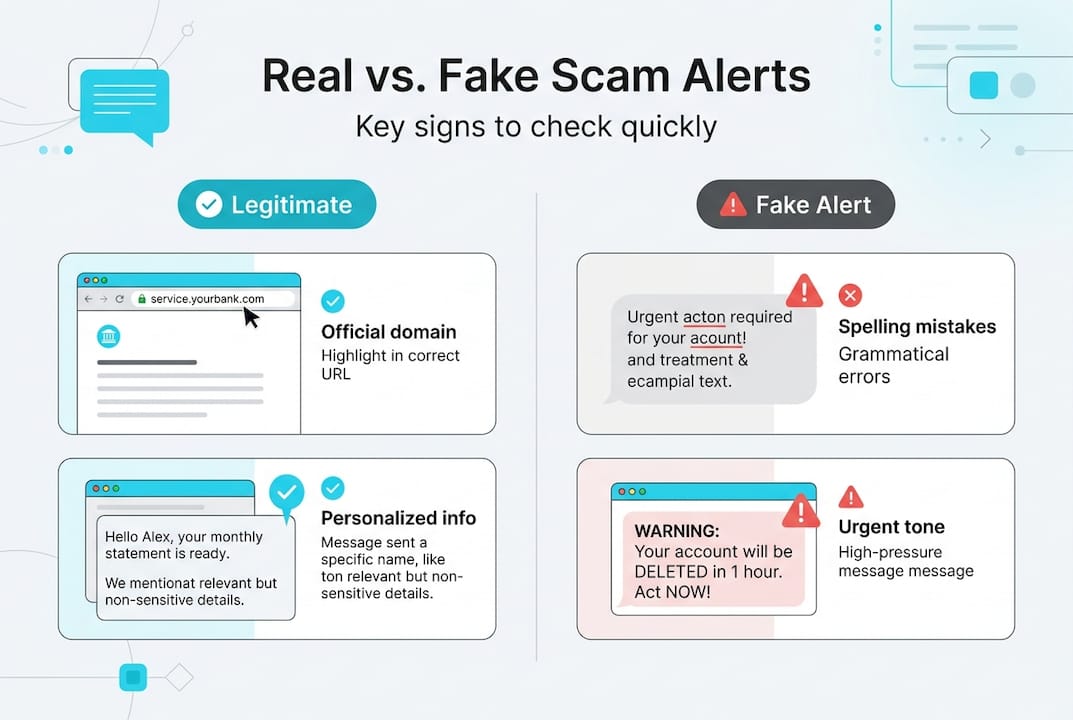
| Feature | Legitimate alert | Fake scam alert |
|---|---|---|
| Sender address | Official domain (e.g., @yourbank.com) | Lookalike or random domain |
| Links | Direct to official website | Redirect to spoofed pages |
| Urgency | Informational, calm tone | Extreme urgency, threats |
| Request | Log in via official app | Click link, call number in message |
| Personal info asked | Never via message | Often requested immediately |
How do scam alerts work? Tactics, triggers, and stats
Understanding the definition is only part of the picture. Next, let's look at exactly how these scam alerts are designed to trick even the savviest internet users.
Scammers are not guessing. They study the format of real alerts and copy them almost perfectly, then layer in panic-inducing language to short-circuit your rational thinking. Fake scam alerts often arrive as texts, emails, or calls claiming issues like suspicious charges and urging immediate action. The goal is to make you react before you think.
Common triggers scammers use include:
- Fake suspicious account activity ("We detected a login from another country")
- Missed package notifications ("Your delivery failed. Reschedule now")
- Overdue bills or unpaid taxes ("Your account will be suspended in 24 hours")
- Security breach warnings ("Your password was exposed. Reset immediately")
- Prize or refund notifications ("You are owed a $500 refund. Claim it now")
One reason these work so well: text open rates reach 98%, giving scammers a massive advantage over almost any other communication channel. Most people open a text within minutes of receiving it, often before they have time to think critically.
The financial damage is staggering. Imposter scams caused $2.95 billion in losses in 2024, making them the third most reported fraud type in the country. That number reflects real people losing real money because a fake alert looked convincing enough.
For practical help with detecting scam texts before you respond, ScamKit offers free tools that analyze suspicious messages instantly. You can also browse recent scam examples to see what current fake alerts actually look like.
Legitimate vs. fake scam alerts: How to tell them apart
With scammers copying real alerts so closely, how can you separate the safe from the dangerous? Here is a practical guide to telling them apart.
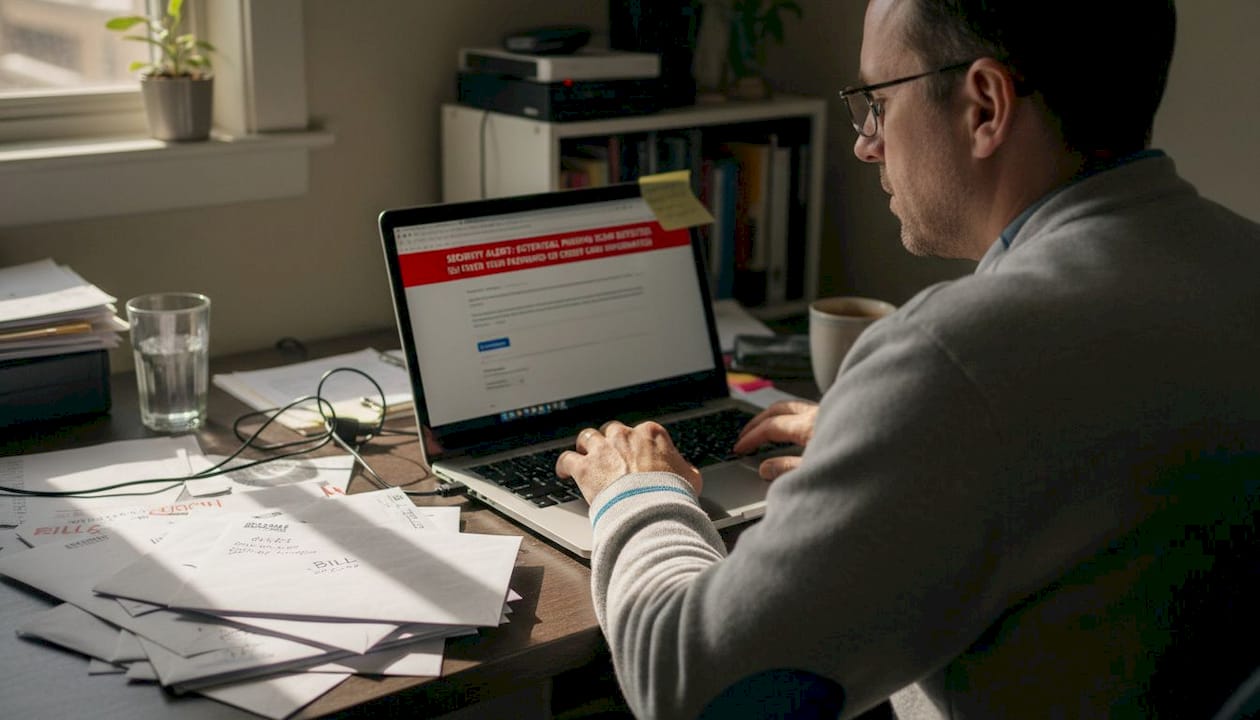
The single most important rule: never use the contact information inside a suspicious alert. If your bank supposedly sent you a warning, go directly to your bank's official website or call the number on the back of your card. Do not call the number in the message. Do not click the link.
To identify fake scam alerts: do not respond, verify through official channels, and avoid clicking any links. Here is a numbered checklist to walk you through it:
- Pause before acting. Urgency is a manipulation tactic. Give yourself 60 seconds to think.
- Check the sender. Look at the full email address or phone number, not just the display name.
- Do not click links. Type the official website address directly into your browser instead.
- Call the company directly. Use a number from their official website or your card or statement.
- Look for grammar errors. Fake alerts often contain subtle spelling mistakes or awkward phrasing.
- Check for personalization. Real alerts usually include your name and partial account info. Vague greetings like "Dear Customer" are a warning sign.
For more help with checking fake emails, ScamKit has a dedicated guide. If you are seeing pop-up warnings on your screen, the tech support scam alerts page explains exactly how those work.
Pro Tip: Scammers now buy stolen data, so they may already know your name, partial card number, or address. An alert that includes your real details is not automatically trustworthy. Always verify through a completely separate channel.
Who is at risk? Age, tactics, and edge cases
Spotting fake alerts also means knowing if you are a likely target and what tricks scammers use to get around your natural skepticism.
The honest answer is that no one is immune. People of all ages, income levels, and tech backgrounds have fallen for scam alerts. But the patterns do differ. Younger users more often report losses, with adults aged 20 to 29 filing the most fraud reports. Older adults, however, tend to lose significantly more money per incident when they are targeted.
Here is what makes modern scam alerts especially hard to dismiss:
- Cloned voices: Scammers use AI to replicate the voice of a bank representative or even a family member.
- Spoofed numbers: The call or text appears to come from your bank's real phone number.
- Real account data: Scammers use real personal data to make alerts sound credible and specific.
- Multi-step attacks: First a text, then a call, then an email, all appearing to confirm each other.
These tactics are increasingly powered by artificial intelligence. Learning about AI-powered scam tactics can help you understand just how realistic these fake alerts have become.
Pro Tip: If something feels off, even if every detail in the alert seems accurate, stop. Hang up. Close the window. Then reach out to the company through a number or website you find independently, not one provided in the alert.
What to do if you get a scam alert: Immediate steps
So you have spotted a suspicious alert. What should you do right now to protect yourself? Here are the critical steps.
Do not respond, click, or pay. Verify through official apps or numbers, and report to the FTC. That is the short version. Here is the full action plan:
- Do not engage. Do not reply, click any link, call any number in the message, or download any attachment.
- Screenshot it. Document the alert before deleting it. You may need it for a report.
- Verify independently. Contact the company using a number or website you find on your own.
- Check your accounts. Log in through the official app or website to see if anything is actually wrong.
- Report it. File a report at report scams to the FTC so others can be warned.
- Strengthen your security. Enable two-step verification on all important accounts and update any reused passwords.
For deeper guidance on spotting deceptive messages, the phishing detection tips page covers email-based attacks in detail. If a suspicious link was involved, the red flag guide walks you through what to look for in a URL before you ever click it.
If you already clicked or shared information, act fast. Call your bank immediately, freeze your credit if financial data was exposed, and change passwords on any affected accounts. Speed matters.
Protect yourself with ScamKit: Powerful tools for safer decisions
The right habits go a long way, but having a reliable tool in your corner makes protecting yourself even easier and faster.
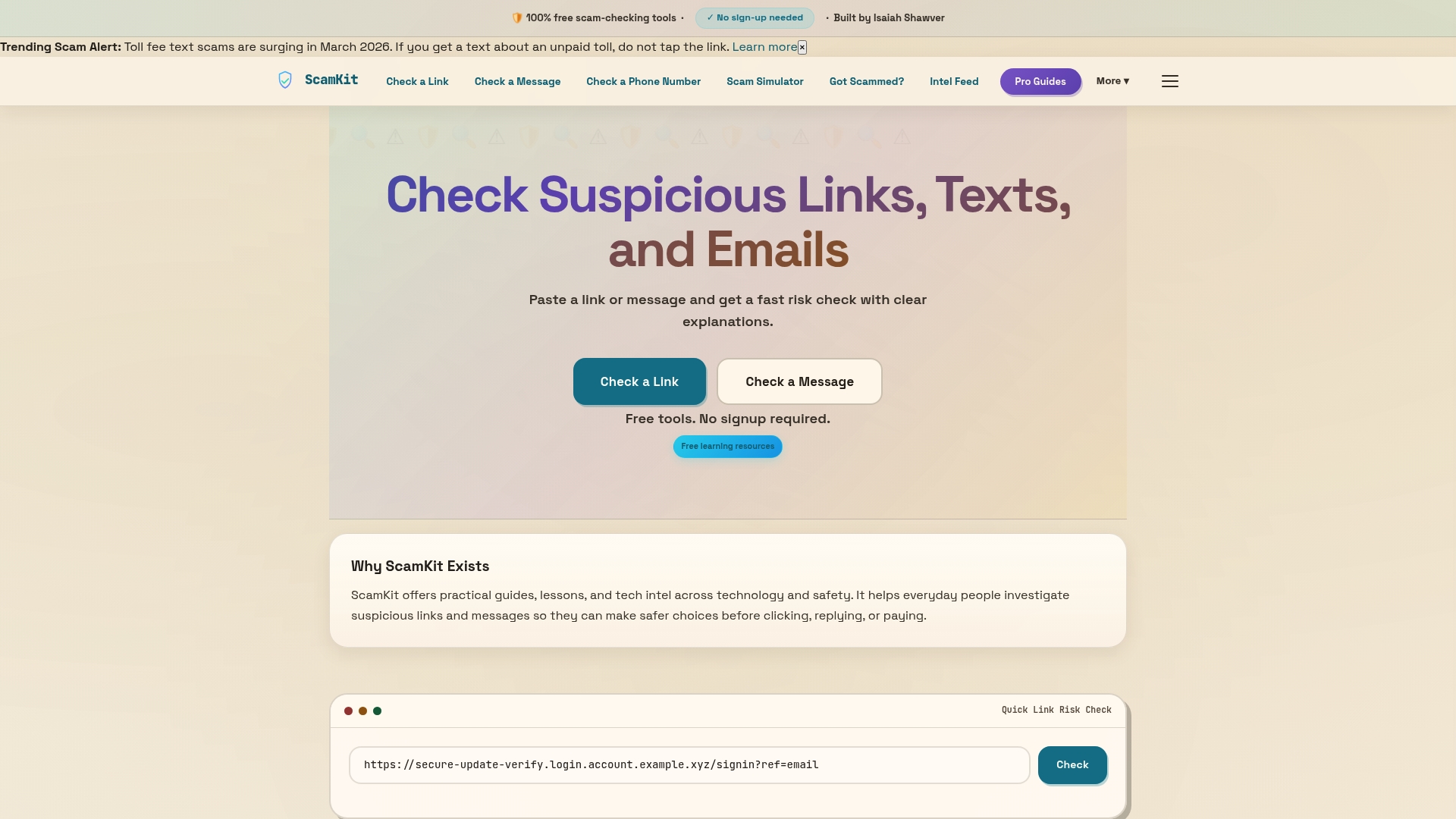
ScamKit is a free platform built specifically for situations like this. When a suspicious alert lands in your inbox or on your phone, you can paste the message directly into the message checker tool and get an instant risk assessment, no sign-up required. It analyzes the language, links, and patterns in the message to flag potential threats before you act. You can also sharpen your instincts with the scam quiz, a short interactive exercise that tests your ability to spot fake alerts in realistic scenarios. ScamKit runs without ads and never sells your data, so every tool is genuinely built to help you stay safe.
Frequently asked questions
How can I spot a fake scam alert quickly?
Look for urgent language and suspicious links demanding immediate action, and always confirm with the company directly using a phone number or website you find on your own, not one provided in the alert.
Are scam alerts always fake?
No. Legitimate organizations like the FTC issue genuine alerts, but imposter alerts can appear identical to real ones, so verification is always necessary.
What should I do if I fall for a scam alert?
Contact your bank immediately, change your passwords, and report scam losses to the FTC so the incident is documented and others can be protected.
Why do scammers use scam alerts?
Because urgency and trust are powerful psychological triggers. People are conditioned to respond quickly to security warnings, which gives scammers a built-in advantage.