
TL;DR:
- US SMS scam losses reached $470 million in 2024, reflecting a rapid rise.
- Recognizing red flags like urgency, unfamiliar numbers, and suspicious links helps prevent scams.
- Combining user vigilance, carrier filters, and AI detection offers layered protection against evolving threats.
US consumers lost $470 million to SMS scams in 2024 alone. That number is staggering, and it keeps climbing. Most people trust a text message the moment it arrives. It feels personal. It feels immediate. But that instinct is exactly what scammers exploit. Whether you're a parent worried about your kids clicking the wrong link, or a small business owner trying to protect your team, knowing how to check a suspicious SMS before you act on it could save you from serious financial and personal harm. This article walks you through everything you need to know.
Table of Contents
- The rise and impact of SMS scams
- How to spot a suspicious SMS: Signs and mechanics
- Advanced detection: Technology, limitations, and practical tools
- Edge cases and new scam evolutions
- A smarter way to protect family and business: What most guides miss
- Take the next step: Practical scam solutions
- Frequently asked questions
Key Takeaways
| Point | Details |
|---|---|
| SMS scams are rising | Text-based scams are becoming more frequent with increasing financial losses each year. |
| Check for red flags | Urgency, suspicious links, spoofed numbers, and unexpected texts are clear signs to investigate further. |
| Tech tools help, but vigilance is key | Machine learning and spam filters support detection, yet human caution is essential for safety. |
| Train family and employees | Education on scams and proactive reporting can prevent attacks in homes and businesses. |
The rise and impact of SMS scams
SMS scams, often called smishing (a blend of SMS and phishing), have grown into one of the most serious online threats facing everyday people. They don't just target tech-savvy users or corporations. They target everyone with a phone.
The numbers tell a clear story. Losses from text scams hit $470 million in 2024, up fivefold from 2020. That's not a slow creep. That's an explosion.
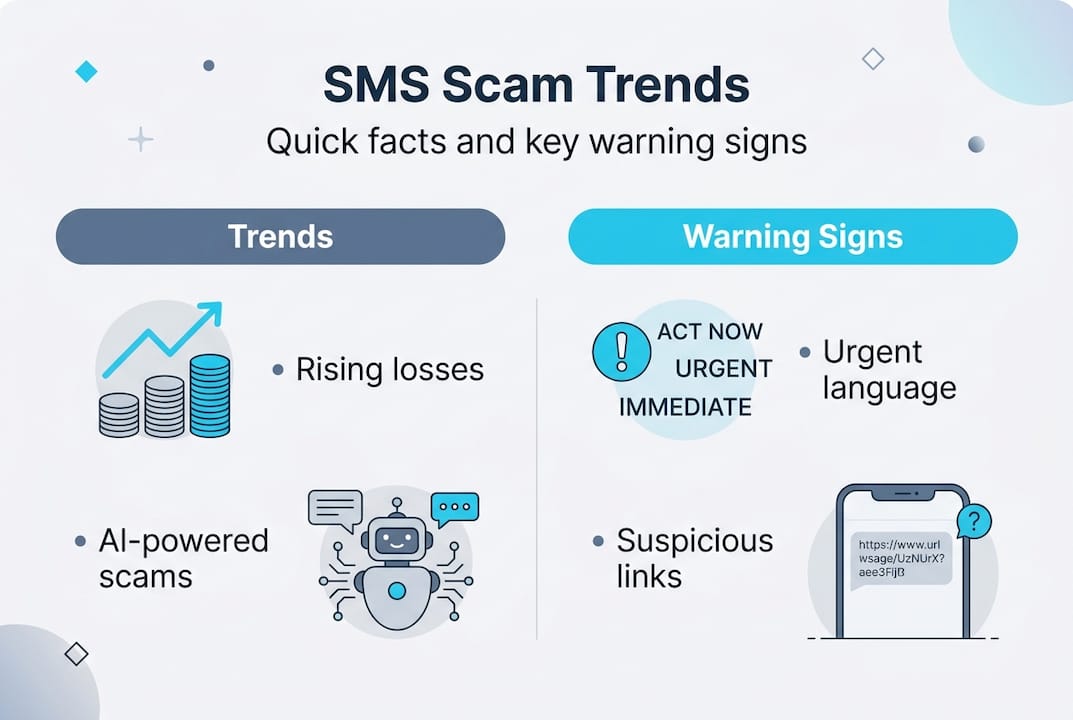
Why is SMS such a prime target? Because text open rates reach 98%, compared to roughly 20% for email. Scammers know you'll see the message. They count on it.
Here's a quick look at how SMS scams compare to other channels:
| Channel | Open rate | Click rate | Scam risk level |
|---|---|---|---|
| SMS | Up to 98% | 8.9% to 14.5% | Very high |
| ~20% | ~2% | Moderate | |
| Social media DM | ~30% | ~3% | High |
The most common SMS scam types you'll encounter include:
- Bank fraud alerts pretending your account is locked
- Package delivery notices from fake USPS or FedEx accounts
- Toll payment demands claiming you owe a small fee
- Job offers that seem too good to be true
- Prize notifications asking you to claim a reward
"Scammers use urgency and impersonation because they work. A message that says 'Your account will be closed in 24 hours' bypasses rational thinking and triggers panic."
Recent trends make things even harder. Scammers now use AI to write cleaner, more convincing messages. They also use quishing, which means embedding malicious links inside QR codes sent via text. You can learn more about that threat in our QR code scam warning guide. And with AI-generated voices and fake personas, it's worth understanding spotting deepfakes as part of your broader awareness.
For small businesses, the risk is compounded. Employees receive texts on personal and work phones. One click on a phishing link can expose customer data, financial accounts, or internal systems. The threat is real and growing fast.
If you're not sure whether a message you received is legitimate, our guide on identifying scam texts is a great starting point.
How to spot a suspicious SMS: Signs and mechanics
Knowing how common and effective SMS scams are, here's how you can recognize suspicious messages before harm happens.
Most scam texts share recognizable patterns. Once you know what to look for, they become much easier to catch. The FTC advises verifying any request independently using official websites or phone numbers, never using contact details provided in the message itself.
Here are the most common red flags:
- Urgency or threats: Phrases like "act now" or "your account will be suspended" are pressure tactics
- Unfamiliar sender numbers: Short codes or random-looking numbers you don't recognize
- Suspicious links: URLs that don't match the company's real domain, or use odd extensions
- Grammar and spelling errors: Many scam texts still contain awkward phrasing or typos
- Requests for personal info: Legitimate companies never ask for passwords or Social Security numbers by text
- Unexpected context: A delivery notice when you haven't ordered anything, or a prize you never entered
One critical rule: never click a link in a suspicious text. Even if the link looks real, it could redirect you to a fake site designed to steal your credentials or install malware.
Pro Tip: If you get a text claiming to be from your bank, hang up mentally and go directly to your bank's official website by typing the address yourself. Call the number on the back of your card. Never use the contact info in the message.
If you're unsure about a text, you have a few safe options. Forward the message to 7726, which is the spam reporting shortcode used by most US carriers. You can also use a spam filtering app, or simply ignore and delete the message. For suspicious calls that accompany these texts, our suspicious phone call guide covers what to do next.
AI-crafted messages are changing the game slightly. They may have perfect grammar and sound completely professional. In those cases, focus less on language quality and more on context. Did you expect this message? Does the request make sense? Is there pressure to act fast?
Advanced detection: Technology, limitations, and practical tools
Spotting suspicious SMS isn't always easy. Let's explore advanced ways technology tackles these threats and where manual checks still matter.
Manual vigilance is valuable, but it has limits. Sophisticated scams, especially those built with AI, can fool even careful readers. That's where technology steps in.
Researchers and security companies use machine learning (ML) and natural language processing (NLP) to detect scam texts automatically. Advanced detection methods include URL analysis, sender metadata checks, and ML models like Random Forest, SVM, and BERT, achieving up to 94% accuracy in controlled settings.
But here's the catch. Real-world performance is messier. User studies reveal only 67% accuracy in detecting fake SMS messages, and just 44% accuracy for identifying real ones, meaning many legitimate texts get flagged incorrectly. That's a significant false positive rate that can erode trust in automated systems.
Here's a comparison of detection approaches:
| Method | Accuracy | Ease of use | Best for |
|---|---|---|---|
| Manual review | Variable | Easy | Individual users |
| Carrier spam filters | Moderate | Automatic | Everyone |
| ML/NLP tools | Up to 94% | Requires setup | Businesses/IT teams |
| URL checkers | High for links | Easy | Anyone with a link |
For most people, a practical layered approach works best:
- Enable carrier spam filters on your phone. Most US carriers offer this for free.
- Report suspicious texts to 7726 so carriers can improve their detection.
- Use a URL checker before clicking any link from an unknown sender.
- Check the sender's number against known scam databases or your contacts.
- Enable multifactor authentication (MFA) on important accounts so even a stolen password isn't enough.
Understanding the AI basics behind these detection tools helps you appreciate both their power and their gaps. And for calls that follow suspicious texts, our phone scam verification tips walk you through a safe verification process.
The bottom line: technology helps, but it's not foolproof. Your own awareness remains the most reliable first line of defense.
Edge cases and new scam evolutions
Beyond traditional SMS scams, there are subtle and evolving threats you should be aware of.
Not every scam follows the obvious playbook. Some of the most dangerous ones are the ones that don't look like scams at all.
Here are the edge cases that catch people off guard:
- Spoofed numbers: Scammers can make a text appear to come from your bank, a government agency, or even a contact in your phone. The number looks real. It isn't.
- AI-crafted messages: These have perfect grammar and personalization, including your name, recent activity references, or location details pulled from data breaches.
- Wrong number texts: A message arrives that seems like a mistake. Someone friendly starts a conversation. Over days or weeks, it evolves into a romance or investment scheme designed to extract money.
- Quishing: QR codes embedded in text messages that link to malicious sites. You scan the code thinking it's a coupon or delivery update, and you land on a phishing page.
Pro Tip: Treat any QR code in a text message with the same suspicion you'd give a random link. Before scanning, ask yourself: did I request this? Does this make sense?
The wrong number scam deserves special attention because it's so patient. Scammers invest weeks building trust before asking for anything. By that point, the victim feels a real connection. These often escalate into fake cryptocurrency investment platforms or emergency money requests.
If you receive a text claiming to be from USPS about a package, check our USPS scam check page before doing anything. And if you buy or sell on social platforms, our Facebook Marketplace scam tips cover how scammers use texts as part of those schemes.
The key takeaway: scams evolve constantly. Staying informed about new tactics is just as important as knowing the classic warning signs.
A smarter way to protect family and business: What most guides miss
Most articles about SMS scams focus on technical tips. Check the link. Look for typos. Report to 7726. That advice is solid, but it misses the bigger picture.
Real security comes from preparing people, not just devices. The most vulnerable targets aren't the ones who ignore warnings. They're the ones who simply haven't been taught what to watch for. Elderly parents, teenagers, and new employees are often the first to get hit.
For families, the best investment is a short, honest conversation about what scam texts look like and what to do when one arrives. Not a lecture. A real talk with examples. Training on non-response to unsolicited urgent texts, combined with carrier spam filters and MFA on key accounts, blocks most attack chains before they start.
For small businesses, appoint one person to handle SMS threat response. That person should know how to report incidents, reset compromised accounts, and brief the team after a close call. Most small businesses don't have an IT department, so this kind of simple structure matters a lot.
Tools like ScamKit for family protection make it easy to set up practical safeguards without needing technical expertise. The goal isn't perfection. It's making your household or team a harder target than the next one.
Take the next step: Practical scam solutions
You now know what to look for, how technology helps, and where the gaps are. The next step is putting that knowledge into action before a scam reaches someone you care about.
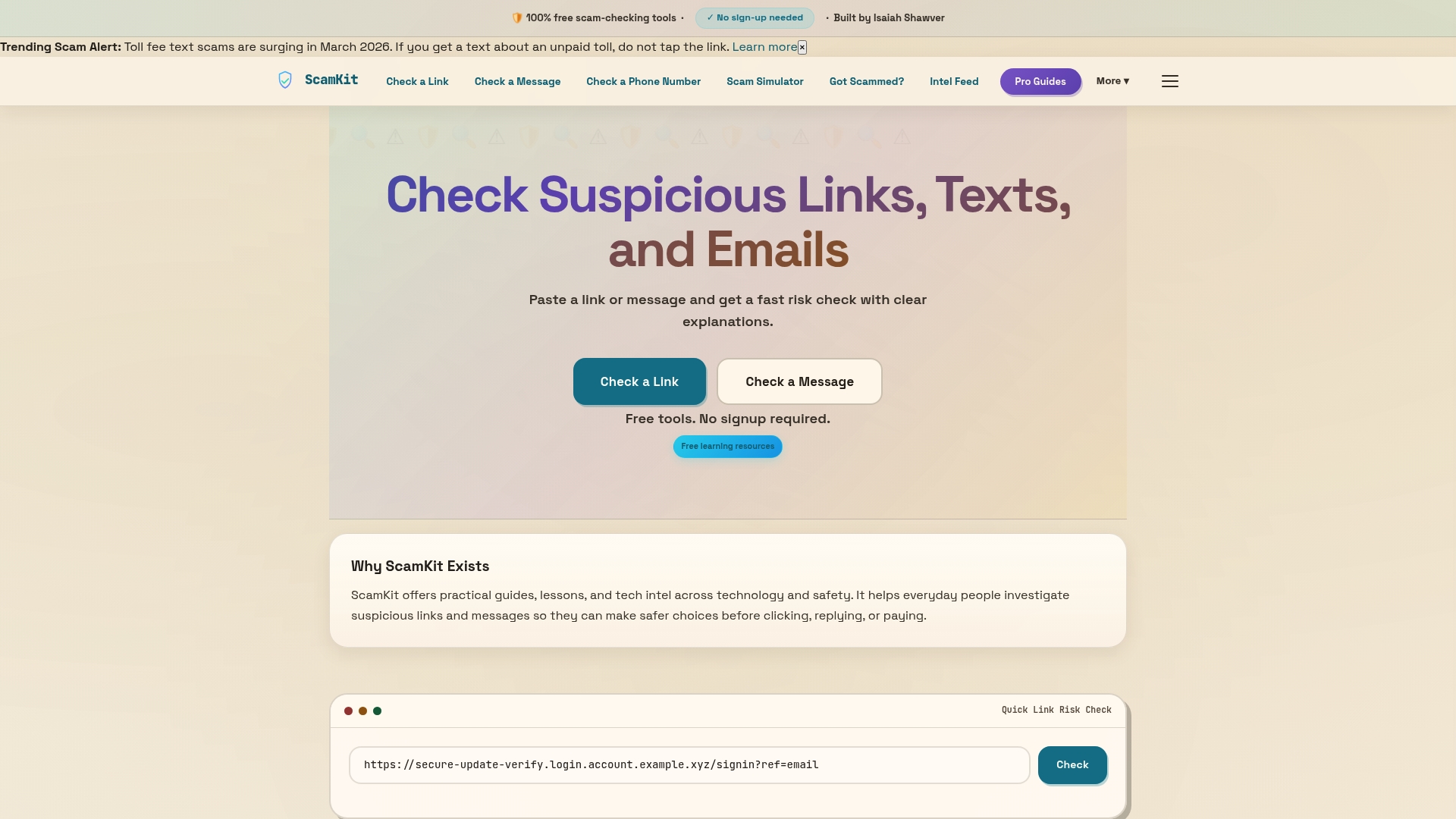
ScamKit gives you free, instant tools to check suspicious links from any text message, no sign-up required. If a message looks off, paste the link and get a risk assessment in seconds. For parents setting up protection for older family members, the setup for family guide walks you through the whole process simply. And if you want to build stronger habits for your household or small business, our proactive cybersecurity resources show you how to stay ahead of threats rather than reacting to them.
Frequently asked questions
How can I verify if a suspicious SMS is a scam?
Go directly to the company's official website or call their published number to verify the message. Never use contact details or links provided in the text itself.
Why are SMS scams more effective than email scams?
SMS messages have open rates up to 98% and click rates between 8.9% and 14.5%, compared to roughly 2% for email, making them far more likely to reach and deceive recipients.
Can AI make it harder to spot SMS scams?
Yes. AI-generated scam texts often feature perfect grammar and personalized details, removing the typos and awkward phrasing that used to be easy red flags.
What should parents and small businesses do to protect against SMS scams?
Train family members and employees to ignore urgent unsolicited texts, report suspicious messages to 7726, and enable multifactor authentication on all sensitive accounts.