
TL;DR:
- Online scams exploit human psychology through urgency and trust, not just technology.
- Imposter scams are the most reported, often involving fake government or familiar authority figures.
- Simple habits like verifying contacts and slowing responses are the most effective prevention tools.
Every day, someone you know is probably targeted by an online scam. Maybe it's a text claiming your bank account is locked. Maybe it's a job offer that sounds almost too good. 7 in 10 adults faced at least one scam attempt in the past year, and 13% say they're hit daily. The financial losses are staggering, and the emotional toll is real. This article breaks down the most common types of online scams, how each one works, the red flags to watch for, and exactly what you can do to protect yourself, your family, and your business.
Table of Contents
- How to identify and categorize online scams
- 1. Imposter scams: Familiar faces turned fraudulent
- 2. Phishing scams: Deceptive emails and texts
- 3. Investment, cryptocurrency, and 'pig butchering' scams
- 4. Romance, job, and other personal scams
- Breakdown: Which scams cost the most?
- Why simple habits, not expensive tech, stop most scams
- Start protecting yourself: Smart tools and resources
- Frequently asked questions
Key Takeaways
| Point | Details |
|---|---|
| Imposter and phishing dominate | These scams are the most common and are designed to exploit trust and create urgency. |
| Investment scams cost more | Crypto and investment fraud cause the highest financial losses, often with elaborate deception. |
| Red flags are consistent | Urgency, requests for money or info, and fake identities appear in nearly all scam types. |
| Simple habits work | Slowing down, verifying requests, and staying skeptical are the best defenses. |
| Tools and training matter | Using scam-check tools and ongoing awareness training greatly reduces your risk. |
How to identify and categorize online scams
With online scams affecting so many people, let's break down the main mechanisms and categories you need to recognize.
Most scams don't succeed because of clever technology. They succeed because they exploit basic human psychology. Scammers create urgency, mimic trust, and pressure you into acting before you think. Understanding that pattern is your first line of defense.
The FTC's small business guidance puts it plainly: scams exploit urgency, trust, and spoofing. For individuals, the advice is to avoid clicking unknown links and verify requests independently. For businesses, the basics are email authentication tools like DMARC, staff training, and multi-factor authentication (MFA).
Here are the five main categories of online scams you'll encounter:
- Social engineering scams (phishing, smishing, vishing): Fake messages designed to steal your credentials or money
- Imposter scams: Someone pretending to be a government agency, business, or person you trust
- Investment and financial scams: Fake opportunities promising high returns, often involving crypto
- Romance scams: Emotional manipulation that leads to money requests
- Job and offer scams: Fake employment or prize offers that require upfront payments
"Urgency words like 'immediate' and 'act now' are common in scam messages, designed to short-circuit your judgment and push you into a fast, unthinking response."
Pro Tip: Before you respond to any unexpected message asking for action, pause for 60 seconds. Ask yourself: did I initiate this contact? If not, verify through a separate channel before doing anything else. You can also review scam avoidance strategies and a practical scam prevention guide to build stronger habits.
1. Imposter scams: Familiar faces turned fraudulent
Now, let's look at the single most reported scam type: imposter scams.
An imposter scam happens when someone pretends to be a person or organization you already trust. That might be the IRS, Medicare, your bank, Amazon, or even a family member in trouble. The goal is always the same: get you to hand over money or personal information quickly, before you have time to think.
Imposter scams are the most reported type of fraud, often involving government agencies, businesses, or family impersonation to create urgency and extract money or information.
A common scenario: you get a call from someone claiming to be a Social Security Administration officer. They say your number has been "suspended" due to suspicious activity. They need you to confirm your details or face arrest. The fear is immediate and real, especially for older adults who may not have seen this script before.
Here's what imposter scams typically look like:
- A fake government agency threatening legal action or benefit suspension
- A "bank fraud department" asking you to move money to a "safe account"
- A tech support agent claiming your computer is infected and demanding remote access
- A family member "in trouble" texting from an unfamiliar number asking for gift cards
- A business contact requesting an urgent wire transfer or invoice change
"If someone contacts you out of the blue and creates a sense of panic, that's the scam. Legitimate agencies don't demand gift cards, wire transfers, or immediate action over the phone."
The most important rule: never use the contact information provided in the suspicious message. Look up the organization's number independently and call them directly. That one habit stops most imposter scams cold.
2. Phishing scams: Deceptive emails and texts
While imposter scams target trust directly, phishing attacks focus on impersonating trusted brands or contacts digitally.
Phishing is the practice of sending fake emails or text messages that look like they come from a legitimate source, like your bank, Netflix, the IRS, or even a colleague. The goal is to get you to click a link, enter your login credentials, or download malware (harmful software) onto your device.
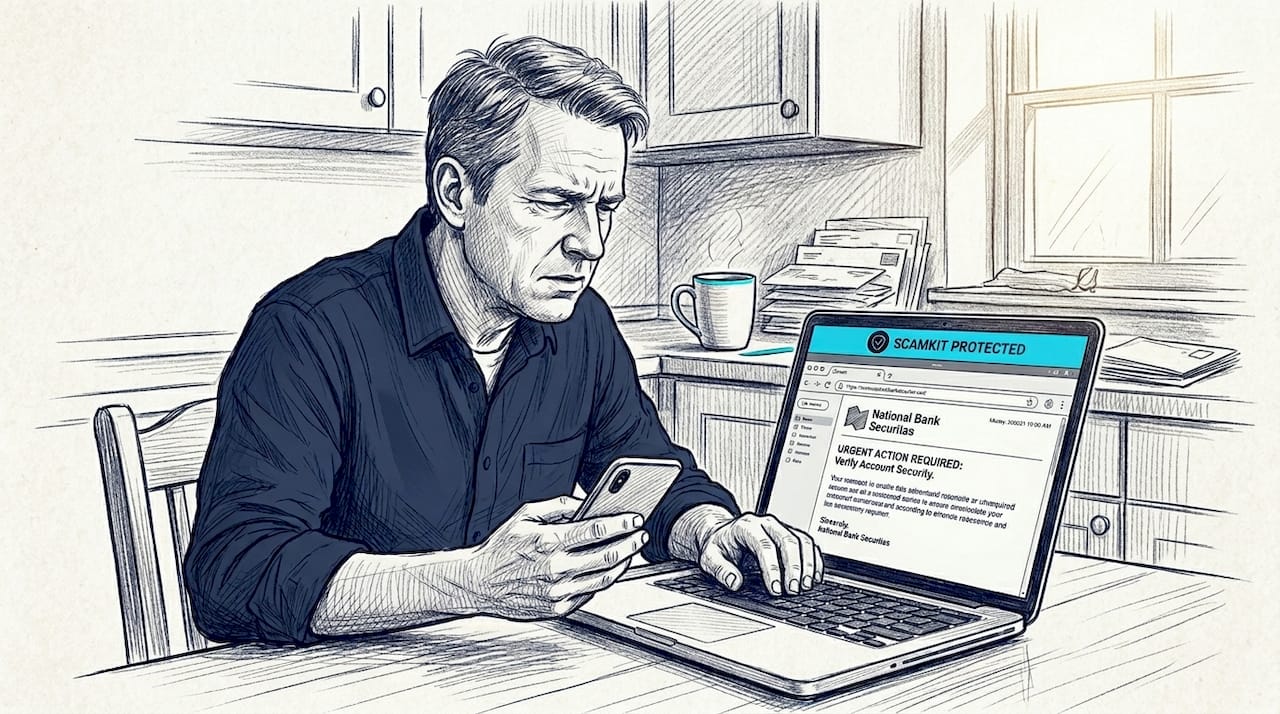
Phishing scams use emails and texts mimicking trusted entities to steal credentials or install malware. Common tactics include fake security alerts, urgent requests, and generic greetings like "Dear Customer."
The FBI's 2025 data tells a sobering story: online scam losses hit $20.9 billion, with phishing topping the list for sheer number of complaints. It's everywhere because it's cheap to run and surprisingly effective.
Watch for these phishing red flags:
- Misspelled sender addresses (like "support@paypa1.com" instead of "paypal.com")
- Generic greetings instead of your actual name
- Urgent language: "Your account will be closed in 24 hours"
- Links that don't match the supposed sender's website
- Requests to confirm your password, Social Security number, or payment info
Pro Tip: Hover over any link before you click it. The actual URL will appear at the bottom of your browser. If it looks strange or doesn't match the company's real website, don't click. You can also check real phishing email examples to train your eye, or read up on smishing and text scam tips if you're getting suspicious texts.
For small businesses, phishing is especially dangerous. One employee clicking a fake invoice email can compromise your entire network. Running regular phishing simulations, where you send fake test emails to staff to see who clicks, is one of the most effective training tools available.
3. Investment, cryptocurrency, and 'pig butchering' scams
With phishing so widespread, criminals also coax larger sums through investment scams. Let's compare the main schemes to watch.
Investment scams are where the real money is lost. Cryptocurrency investment fraud alone accounted for $7.2 billion in losses in 2025. One of the most dangerous variations is called "pig butchering," a term that refers to fattening up a victim before the slaughter.
Here's how pig butchering works: a stranger contacts you on a dating app, social media, or even by "wrong number" text. They're friendly, patient, and build a relationship over days or weeks. Eventually, they mention an amazing investment opportunity, often involving a crypto trading platform. They show you "profits" on a fake dashboard. You invest more. Then, when you try to withdraw, you're told you need to pay fees first. You pay. Nothing comes back. The platform disappears.
Pig butchering scams promise high returns via fake platforms, where victims see fabricated gains and then face endless withdrawal fees before losing everything.
The FTC reports that total fraud losses in 2024 reached $12.5 billion, up $2.5 billion from the year before. Investment scams alone accounted for $5.7 billion, with a median loss of $9,000 per victim.
| Scam type | How it starts | What they want | Avg. loss |
|---|---|---|---|
| Pig butchering | Fake relationship, wrong-number text | Crypto deposits | $10,000+ |
| Ponzi/pyramid | Unsolicited investment offer | Upfront investment | Varies |
| Fake trading app | Social media ad or message | Crypto or wire transfer | $9,000 median |
| NFT/token scam | Online community or DM | Crypto wallet access | Varies |
Red flags for investment scams:
- Promises of guaranteed high returns with no risk
- Pressure to act quickly before the "opportunity closes"
- Requests to use a specific platform you've never heard of
- Fake dashboards showing impressive gains
- Fees required before you can withdraw
For a deeper look at how these scams operate, the pig butchering scam analysis on ScamKit walks through real case examples and warning signs in detail.
4. Romance, job, and other personal scams
Beyond money and data, scammers often prey on our emotions and ambitions through romance and job offers.
Romance scams are particularly cruel. A scammer builds a fake relationship with you over weeks or months, often using a stolen photo and a fabricated life story. Once they've earned your trust and affection, the "emergency" arrives. They need money for a medical bill, a plane ticket to visit you, or to get out of a dangerous situation. Romance scams build fake relationships online to solicit money for exactly these kinds of manufactured crises.
Job scams are booming too, especially as remote work has normalized online hiring. You apply for what looks like a real position. You get an offer. Then you're asked to pay for training materials, a background check, or equipment upfront. The job doesn't exist. Job scams offer fake employment requiring upfront fees for training or equipment, and they're especially common on freelance platforms and LinkedIn.
Watch for these warning signs across both scam types:
- A person or employer who contacts you first, out of nowhere
- Stories that keep changing or don't quite add up
- Requests for money, gift cards, or wire transfers
- Pressure to move communication off the official platform
- Offers that are unusually generous for the role or relationship
Pro Tip: If a romantic interest online has never video-called you despite weeks of chatting, that's a serious red flag. Ask for a live video call. Scammers using stolen photos will almost always refuse or make excuses.
Here's a quick action plan if you suspect a romance or job scam:
- Stop sending money immediately, even if you've already sent some
- Save screenshots of all messages and contact details
- Report the account on the platform where you were contacted
- File a report with the FTC at reportfraud.ftc.gov
- Contact your bank if you've made any payments
You can explore romance scam warning signs, job scam red flags, and even student and internship scams if you're a younger adult navigating the job market.
Breakdown: Which scams cost the most?
After exploring the most common scam types, let's see how their risk levels and financial impact stack up.
Not all scams are equal in terms of how often they happen versus how much they cost. Phishing is the most frequently reported scam, but investment fraud causes the most financial damage by a wide margin.
| Scam type | Frequency | Estimated losses | Highest-risk group |
|---|---|---|---|
| Phishing | Very high | Part of $20.9B total | All adults |
| Imposter scams | Highest reported | Significant | Older adults |
| Investment/crypto | Moderate | $7.2B (crypto alone) | Adults 30-60 |
| Romance scams | Moderate | Hundreds of millions | Adults 40-70 |
| Job scams | Growing | Billions annually | Young adults |
Key stat: Older adults lose more per incident than any other age group, and low-income households are three times more likely to lose money to scams. Social media contact leads to a 70% loss rate, meaning if a scammer reaches you through Facebook, Instagram, or a dating app, the odds of financial loss are alarmingly high.
Social media deserves special attention. It's become the preferred hunting ground for scammers because it's easy to fake a profile, build trust, and reach thousands of people at once. If someone you don't know well is messaging you about money, investments, or urgent favors, treat it as a scam until proven otherwise.
Why simple habits, not expensive tech, stop most scams
Here's something the cybersecurity industry doesn't always want to admit: the most effective scam prevention doesn't come from expensive software. It comes from slowing down and thinking.
The biggest scams succeed by targeting human psychology, not technical vulnerabilities. A grandmother rushing to the bank to wire money to a "kidnapped" grandchild isn't failing at cybersecurity. She's being manipulated by someone who knows exactly how to create panic. No firewall stops that. Awareness does.
The uncomfortable truth is that most people and small businesses overspend on technology and underspend on training and awareness. A $500 security subscription won't protect an employee who clicks a phishing link because they didn't know what one looked like.
The habits that actually work are simple. Slow down before you act on any unexpected message. Verify requests through a separate, known contact method. Turn on two-factor authentication (a second verification step beyond your password) on every important account. Maintain healthy skepticism, especially when something feels urgent or too good to be true.
For businesses, the same logic applies. Regular conversations with your team about current scam tactics are worth more than most tech tools. Share examples. Run practice drills. Make it normal to say, "I got a weird email today, let me check before I click."
Everyday scam-avoidance techniques don't require technical expertise. They require consistency. The scammers are counting on you to be in a hurry. Don't give them that advantage.
Start protecting yourself: Smart tools and resources
Putting these habits into action is easier with the right resources. Here's how you can get started today.
ScamKit offers free, no-signup tools designed for exactly this purpose. Whether you're unsure about an email, a phone call, or an investment offer, you don't have to guess.
You can analyze suspicious email headers to see if a message is really from who it claims to be. If you've received a suspicious call or text, you can check phone numbers for scams instantly. And if you want to sharpen your scam-spotting skills before you're ever in a real situation, try a scam simulator that walks you through realistic scenarios. All tools are free, private, and built for people who want protection without complexity.
Frequently asked questions
What type of online scam is most common in 2026?
Imposter scams remain the most reported type, often involving government, business, or family impersonation to create urgency and extract money or information.
Which online scams lead to the biggest financial losses?
Investment scams, especially involving cryptocurrency, cause the highest total dollar losses. Crypto investment fraud alone accounted for $7.2 billion in 2025 according to FBI data.
Who is most at risk of losing money to online scams?
Older adults lose more money per incident than any other group, and low-income households are three times more likely to lose money, with social media contact significantly increasing the risk.
How can small businesses protect themselves from online scams?
Train staff regularly, implement email authentication tools like DMARC, verify payment changes by phone through known contacts, and report incidents to the FTC or FBI's IC3.
What is a quick way to check if a message or offer is a scam?
Look for urgency, requests for money or personal information, misspellings, or unfamiliar links. Fake alerts and urgent requests are the most common phishing tactics, and verifying independently is always the safest move.