
TL;DR:
- Scammers target individuals because they are easier to manipulate psychologically than businesses.
- Common scams include impersonation, urgent threats, and emotional manipulation, especially targeting seniors and parents.
- Slowing down, verifying through official channels, and involving others are key to preventing scams.
Last year, a friend of mine almost wired $4,000 to someone pretending to be her bank's fraud department. She isn't naive. She's sharp, careful, and tech-savvy. But the caller knew her name, her bank, and the exact amount of her last transaction. She almost fell for it. And she's not alone. Total fraud losses hit $12.5 billion in 2024 according to the FTC, with individuals bearing the vast majority of that burden. If you think scams only happen to careless people, this article will change your mind and give you the tools to protect yourself and the people you care about.
Table of Contents
- Why individuals are prime targets for scams
- How scammers operate: Methods and strategies
- Who gets targeted: High-risk groups and real impact
- Why scams succeed: The psychological edge
- Our take: What most advice overlooks about scam targeting
- Protect yourself with smarter tools
- Frequently asked questions
Key Takeaways
| Point | Details |
|---|---|
| Individuals are easy targets | Scammers focus on individuals because they are easier to manipulate and often lack security protocols. |
| Biggest losses hit seniors | Seniors and other vulnerable groups suffer the largest financial losses from scams each year. |
| Emotional and psychological tactics | Scams work by exploiting urgency, trust, and emotional connections to bypass your usual caution. |
| Pause and verify | The most effective defense is to slow down, question urgency, and independently verify any suspicious request. |
Why individuals are prime targets for scams
Scammers are running a business. They want the biggest return for the least effort. That's why they overwhelmingly focus on individuals rather than companies.
Businesses have IT departments, fraud monitoring software, and formal approval processes before money moves. Individuals have none of that. There's no second layer of review. No compliance officer asking questions. Just one person, one moment, and one decision.
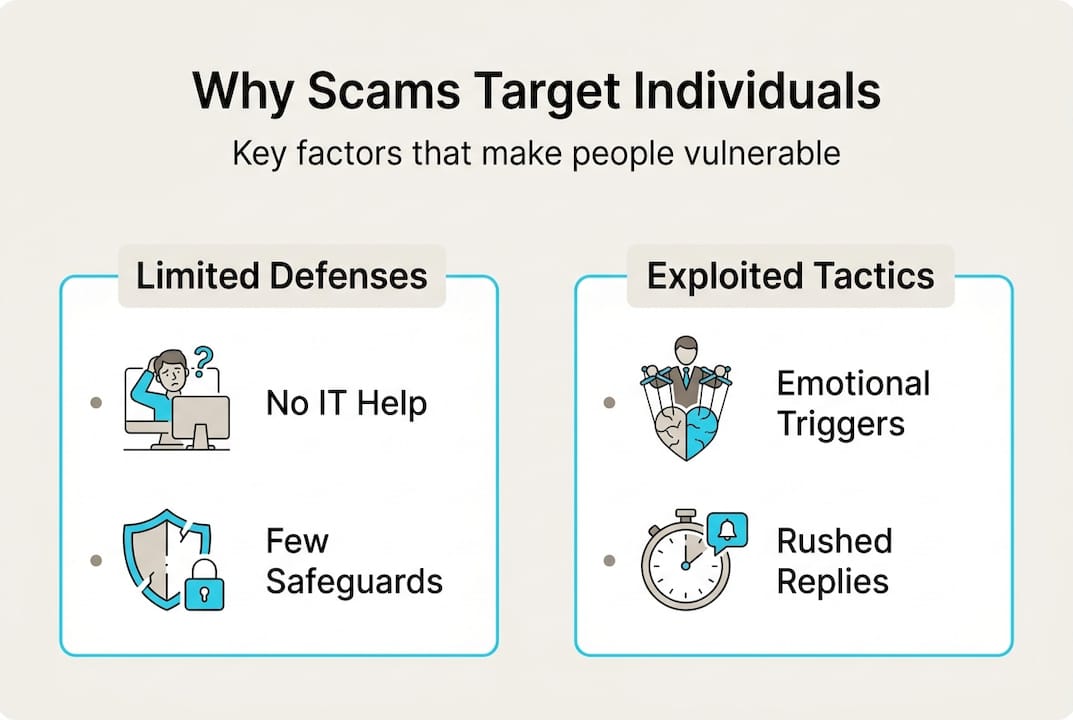
But the real reason goes deeper than systems. Scammers target individuals because they are far easier to manipulate psychologically than businesses. Humans are wired to trust, to help, and to respond quickly when someone in authority tells us there's a problem. Scammers know this and exploit it deliberately.
Here are the core psychological levers scammers pull:
- Trust: We're raised to trust authority figures like police, banks, and government agencies.
- Urgency: When someone tells you your account is about to be frozen, your brain shifts into panic mode.
- Authority bias: A caller who sounds confident and uses official language automatically earns credibility.
- Fear of loss: The threat of losing money or facing legal trouble overrides rational thinking.
- Empathy: Emotional stories about sick grandchildren or disaster relief are powerful motivators.
Personal situations make things worse. Someone who lives alone, recently lost a spouse, or is going through financial stress is especially vulnerable. Seniors in particular often face a combination of trust, isolation, and accumulated savings that make them prime targets. Parents are targeted through their kids, with fake emergencies designed to trigger immediate action.
"The psychological manipulation behind scams isn't about targeting stupid people. It's about targeting human beings." That's a critical distinction.
Reading up on scam avoidance strategies and building safer digital practices can help break these automatic responses before a scammer gets the chance to exploit them.
How scammers operate: Methods and strategies
Knowing why you're a target is step one. Knowing how scammers actually reach you is step two.
The delivery methods are mostly simple and low-tech. Phone, email, and text are still the dominant channels, often following an initial hook online through social media or fake websites. These methods cost almost nothing to scale, which means scammers send millions of messages hoping a small percentage of people respond.
Here's a breakdown of the most common scam tactics used against individuals:
| Tactic | How it works | Common target |
|---|---|---|
| Government impersonation | Fake IRS, Social Security, or police contact | Seniors, general public |
| Bank fraud alerts | Spoof calls mimicking your real bank | All age groups |
| Grandparent scams | Caller pretends a grandchild is in danger | Seniors |
| Prize and lottery scams | "You've won" messages requiring fees | General public |
| Tech support scams | Pop-ups claiming your device is infected | Seniors, remote workers |
| Romance scams | Fake emotional relationships online | Isolated adults |
Every one of these scams relies on the same core formula: establish trust, create urgency, and demand action before the target has time to think.
Here's what makes them especially effective:
- Scammers research their targets using social media and data breaches.
- They use spoofed phone numbers that look like real local businesses or government agencies.
- They apply pressure to prevent victims from consulting anyone else.
- They specifically instruct victims not to tell family members or bank tellers.
That last point is telling. Scammers know that a second opinion kills the con. That's exactly why they push so hard for secrecy and speed.
If you're unsure about a call, you can check scam calls or learn about spotting text scams before you respond to anything.
Who gets targeted: High-risk groups and real impact
Scams don't affect everyone equally. Certain groups face significantly higher risk, and the financial damage is staggering.
Seniors aged 60 and older are the hardest hit. The FBI IC3 2024 report found that individuals in this age group reported losses of between $4.8 billion and $5 billion in a single year. That figure alone should stop you cold.
Why seniors? Several factors combine. They're more likely to answer unknown calls. They often have retirement savings that can be accessed quickly. And they may be less familiar with newer scam tactics. Crucially, many live alone, which means there's no one nearby to raise a red flag.
Parents are targeted differently. The grandparent scam is one of the most emotionally brutal tactics in use. A caller claims your grandchild has been in an accident or arrested. They beg you not to tell anyone. They want cash, immediately. The FDIC notes that family-based emotional appeals are among the most effective manipulation tools scammers deploy.
Small business owners face their own risks. They're often targeted through business impersonation scams, fake invoices, and supplier fraud. Unlike large corporations, they don't have dedicated fraud teams to catch irregularities early.
Here's a comparison of how different groups are typically targeted:
| Group | Primary vulnerability | Common scam type |
|---|---|---|
| Seniors (60+) | Trust, isolation, savings | Government, tech support, romance |
| Parents | Family emotional ties | Grandparent, fake emergency |
| Small business owners | Authority, time pressure | Invoice fraud, impersonation |
| Young adults | Online activity, confidence | Phishing, fake jobs, crypto |
Stat to know: Seniors lost nearly $5 billion to fraud in 2024. That's more than most people realize is even possible.
Pro Tip: If you're a caregiver or family member of a senior, have a code word system. If anyone calls claiming a family emergency, they must know the word. It takes 30 seconds to set up and could save thousands.
If you or someone you know has already been affected, there are clear steps you can take to recover from scams. And studying scam templates helps you recognize the patterns before they hit.
Why scams succeed: The psychological edge
Even careful people fall for scams. That's not a character flaw. It's neuroscience.
When someone triggers fear or urgency in your brain, your prefrontal cortex, the part responsible for rational decision-making, gets partially bypassed. Your brain shifts into survival mode. You act fast. You stop asking questions. That's exactly what scammers want.
Research confirms this. People fall for implausible scams not because they're gullible, but because they're making a kind of unconscious bet. If there's even a small chance the threat is real, the emotional cost of ignoring it feels too high. Victims often sense something is off but talk themselves into compliance anyway.
Here are the four key psychological mechanisms scammers rely on:
- Authority: Someone who sounds official gets automatic trust. A scammer in a uniform, a badge number, or a professional title bypasses our skepticism.
- Urgency: Time pressure shuts down deliberate thinking. "You have 30 minutes or your account will be closed" is a deliberate psychological weapon.
- Isolation: By cutting you off from advisors or family, scammers remove your natural safety net.
- Intermittent reward: In romance scams especially, a cycle of warmth and withdrawal creates emotional dependency that makes victims overlook red flags.
Pro Tip: The moment you feel panicked by a message or call, treat that panic itself as a warning sign. Legitimate organizations do not pressure you to act immediately without time to verify.
So what can you do right now?
- Pause: Give yourself at least 10 minutes before responding to any urgent message.
- Verify independently: Call the official number on your bank's website, not the one in the message.
- Tell someone: Even a quick text to a friend breaks the isolation scammers depend on.
- Never send money to "protect" assets: No legitimate institution will ever ask you to wire money for your own protection.
Building these habits around avoiding scam techniques makes a real difference, especially in the moments when pressure is highest.
Our take: What most advice overlooks about scam targeting
Most scam prevention advice is a checklist. Don't click unknown links. Don't share your password. Use two-factor authentication. All good advice. But it misses the point entirely.
The real vulnerability isn't technical. It's social. Scammers succeed because they isolate you and accelerate your decision-making. No checklist stops that.
What actually works? Slowing down and involving another person. It sounds almost too simple. But when someone else knows what's happening, the scam dynamic collapses. The urgency fades. The pressure dissolves. You can think clearly again.
We've seen this play out repeatedly. The people who avoid getting scammed aren't the most tech-savvy. They're the ones who paused and said, "Let me check with my daughter first" or "I'll call the bank back on their official number."
The guidance from Scamwatch backs this up: pause when you feel urgency or fear, verify using official channels, and never send money or access to "protect" your assets. Monitor your accounts and educate your family.
That's the real defense. Not just knowing about scams. Disrupting the conditions that make them work. Lean on our practical scam avoidance resources when you're not sure what to do next.
Protect yourself with smarter tools
Understanding the threat is powerful. Having the right tools makes it practical.
ScamKit was built exactly for this. When you get a suspicious link in a text or email, you can scan suspicious links instantly and get a clear risk rating before you click. If you're unsure about an email, you can analyze suspicious emails and see the warning signs laid out in plain language.
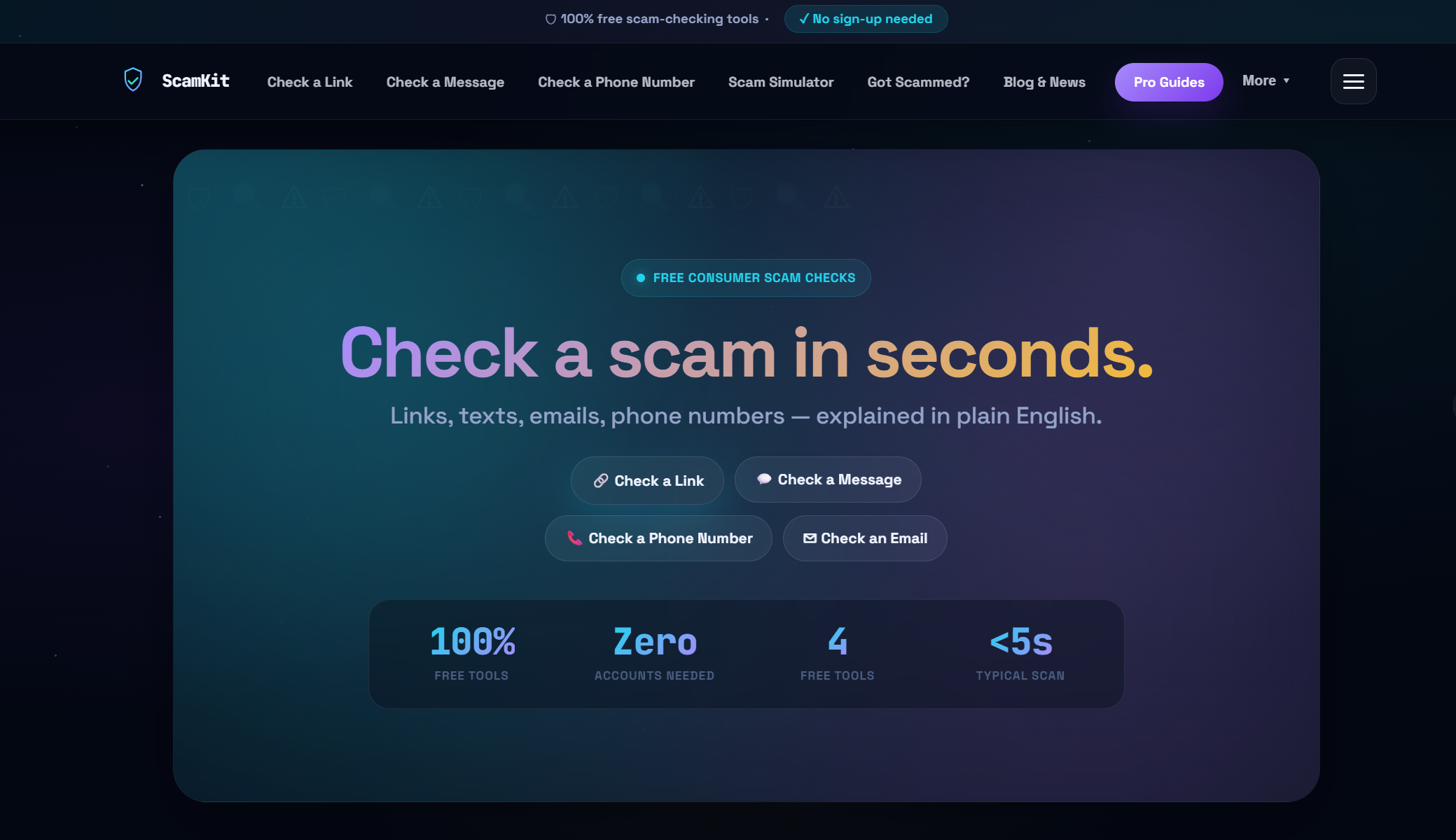
No sign-up required. No personal information collected. Just fast, free answers when you need them most. Whether you're protecting yourself, a parent, or a small business, ScamKit gives you a fighting chance. You can also learn about proactive cybersecurity and stay ahead of threats rather than reacting to them after the damage is done.
Frequently asked questions
Why do scammers prefer targeting individuals over businesses?
Individuals are easier to manipulate psychologically and rarely have the formal security systems that businesses use to catch fraud before it happens.
Who is most vulnerable to scams?
Seniors, parents, and small business owners face the highest risk. The FBI IC3 2024 data shows seniors alone lost close to $5 billion in a single year.
How do scammers usually make contact?
Most scammers reach out through phone calls, emails, or text messages that impersonate trusted institutions, such as banks, government agencies, or even family members in crisis.
What is the most important way to avoid scams?
Pause before reacting, verify using official contact information, and never send money under pressure. The core protective guidance consistently comes back to those three steps.